
Illinois Previous Residents: Era Records
Illinois records sit with different custodians and have different coverage. A deed index names a grantor, who transfers an interest, and a grantee, who receives it. Assessor data anchors a parcel; deeds show transfers, while directories, census schedules, and permits add dated household or building evidence. Online cutoffs vary by county, as the table shows.
| Source | Years Covered | Where Held | What It Shows |
|---|---|---|---|
| Cook County deed index example | Computer-indexed 1985-present; pre-1985 tract books require an in-person search | Cook County Clerk Recordings | Recorded instruments and their parties; older books are a counter/archive route |
| Illinois recorder indexes | Grantor/grantee index requirement dates to 1847; rules codified in 1874 | County recorder or county clerk acting as recorder; Illinois Regional Archives Depository (IRAD) where held | Deeds, mortgages, liens, plats, tax deeds, and other land instruments; actual runs vary |
| Chicago city directories | Newberry runs: 1839, 1844, 1849-50, 1851, 1853-57, 1859-68, 1870-1917, 1923, 1928-29 | Newberry Library and local collections | Names and addresses in surviving years; publishers and sections vary |
| Peoria city directories | 1844-1916, non-inclusive; another catalog lists 1872-1977 at about ten-year intervals | Peoria Public Library, FamilySearch, and area libraries | Selected address and name entries; verify each volume and year |
| Federal census schedules | 1810-1860 early Illinois indexes; 1900-1920 indexed heads at Archives; 1930 microfilm; 1950 released; 1890 destroyed | Federal archives, Illinois State Archives, FamilySearch, and library databases | Household age and relationship evidence; generally not an annual address roll |
| Chicago building permits | 1872-1955 guide; online Chicago Buildings records cover the recent 36 months | UIC microfilm, Chicago Department of Buildings, and the Landmarks guide | Permit applicant, structure details, inspections, and cost; older index gaps exist |
| Sanborn maps | Varies by Illinois city; many local runs extend from the late 1800s into the 1930s or 1950s | Local libraries, university map rooms, and digitized collections | Building footprint, materials, use, and lot context, not resident names |
Begin with the assessor or county GIS for the current parcel and its property index number (PIN), lot, and legal description, the lot, block, or tract wording that identifies the land. For a modern transfer in Cook County, the Clerk Recordings index is the online path; an older Cook chain needs tract books or counter help. In another county, ask the local recorder where its index stops and whether older books, microfilm, or the Illinois Regional Archives Depository (IRAD) fill the gap.
Illinois and Cook County's 1985 Deed Cutoff
Cook County provides a clear example of why a single online name search may stop short of a full house history. Its Clerk Recordings page is the county's entry point for land records, searches, and document-copy access. The computer-indexed run begins in 1985; older tract books require an in-person search according to the county's historical access material. That is an access boundary for Cook, not a rule for every Illinois recorder.
Ask the recorder which tract-book or volume sequence matches the parcel description and last known instrument number. Fees, copy methods, and online images vary by county. Search the Illinois Regional Archives Depository system by county for transferred records; contact the recorder if it does not hold that deed series.
The Cook County Clerk Recordings page is the official land-record entry point pictured here; its online index does not include the entire county chain.
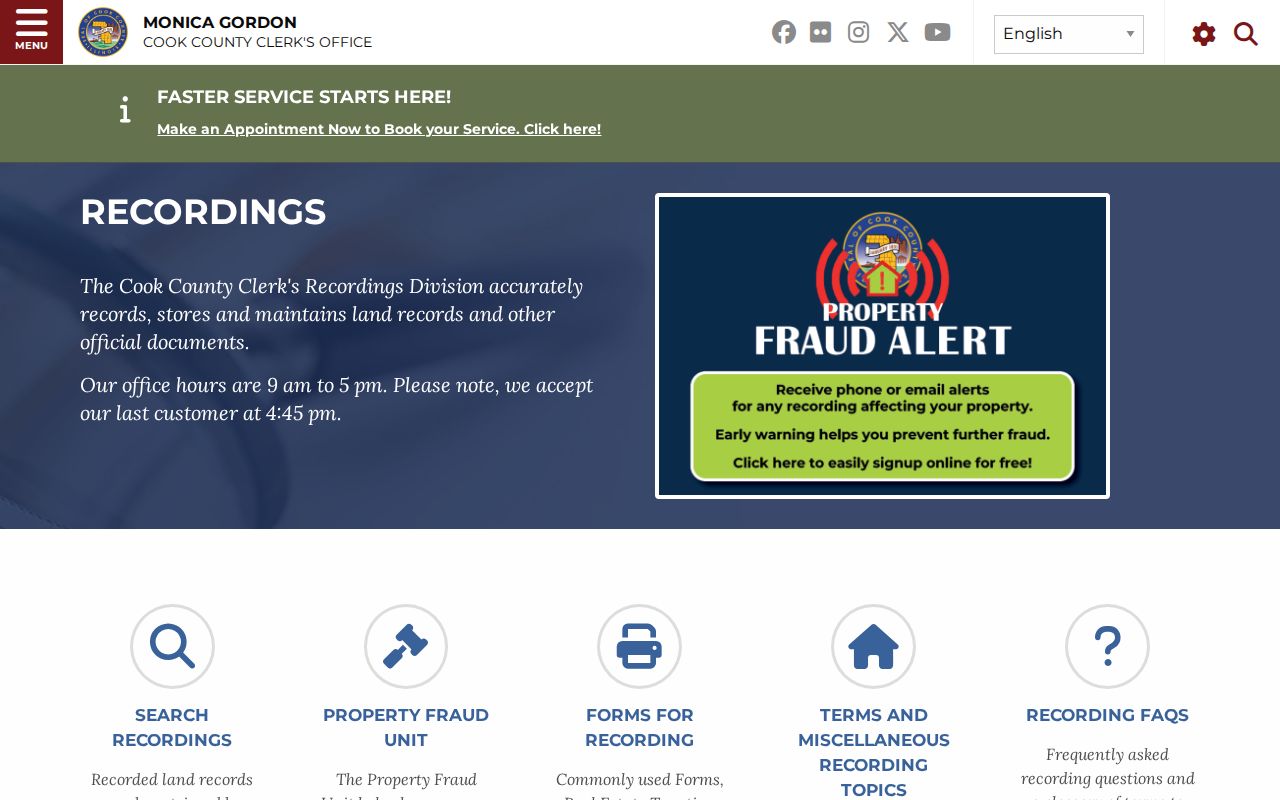
Older records require tract books and in-person service.
Illinois Recorder Indexes Begin in 1847
The county land-record system has a long paper history. Illinois required grantor and grantee real-estate indexes in 1847, and the 1874 statutes codified deeds, indexes, maps, plats, and optional abstracts. Between those dates, constitutional changes shifted recorder duties: the 1848 Constitution transferred the work to circuit clerks, while the 1870 Constitution restored recorders in counties with populations of 60,000 or more. In 1963, county clerks became ex-officio recorders in counties under that population level.
This history helps explain why an old volume may sit with a clerk, a recorder, or an archive, depending on county and era. The State Archives' recorder description lists the historical record types and the office's changing role. The record-field finding aid describes the index entries. These are guides, not statewide indexes of every deed. Confirm the responsible local custodian before requesting a book or image.
Trace Illinois Previous Residents by Deed
A deed chain begins with today's parcel and follows recorded instruments to earlier owners. First fix the parcel with an assessor record or map, then use its PIN or legal description to find the related deed. In Cook County, the assessor address search accepts address and PIN routes, while CookViewer can locate a property by address, PIN, or intersection and show a historical parcel layer. A situs address is the property's physical location; a mailing address may differ, so keep them in separate notes.
- Save the current owner, PIN, legal description, subdivision, lot and block, situs address, and mailing address.
- Search the recorder index by PIN or legal description when available; otherwise search the current owner's name as grantee.
- Open the current purchase deed and record the date, instrument number, book and page, parties, legal description, and prior-instrument references.
- Search the seller or grantor as the next grantee, checking a referenced earlier instrument when one appears.
- Repeat until the online index ends, then use the recorder counter, tract books, microfilm, county archive, or IRAD for the appropriate county.
Names alone can mislead. A trust, estate, company, lien claimant, or person with a common name may appear in the index. Match the legal description and instrument type before adding a party to the chain.
- Grantor / grantee
- The grantor transfers or releases an interest; the grantee receives the interest or release named in the instrument.
- Chain of title
- The sequence of recorded transfers that links a parcel's present interest to earlier ones.
- Legal description
- The lot, block, tract, or other land wording that identifies the property more precisely than a street number.
- Criss-cross directory
- A street-order or address-based directory section used to move from a location to a listed name.
- Enumeration district
- The area assigned to a census taker; its boundaries can help locate a household in an unindexed schedule.
Illinois Previous Residents and 1909 Addresses
Chicago changed north- and west-side street addresses in 1909. The Lakeside Directory published an old/new conversion list, and the house-history guide notes that a permit card may carry a second, older number. When an address search seems to skip a house, check the former number before deciding the parcel has no earlier record. A street name, direction, and nearby lot can help distinguish a true match from a similar address.
This conversion is especially useful when comparing an old Chicago directory with a current parcel. It is not a statewide conversion date: other Illinois municipalities have their own street renaming, annexation, and readdressing histories. Ask a municipal clerk, planning office, local library, or GIS staff about the relevant local map or address history rather than deriving a new number by guesswork.
Illinois Previous Residents: Chicago Permit Records
Chicago's “Your House Has a History” guide provides a separate building trail that can add dates and physical detail to a deed chain. UIC's Documents & Maps Department and Special Collections, at 801 S. Morgan Street, hold address-index cards and permit ledgers on microfilm. The guide's workflow is simple: locate the address card, then use its ledger book and page reference. The card can list the property address, building type, permit number and page, file number, and date.
The ledger may add the named owner, architect, contractor, dimensions, inspection notes, and construction cost. The 1872-1911 address index has missing addresses, and the earlier ledger system is arranged by city section, so a failed card search does not prove that no permit exists. The 1912-1955 ledgers are more comprehensive. The Chicago Buildings permit search covers only the recent 36 months online; older research needs the guide's microfilm or the Department of Buildings' records process.
The Chicago house-history guide gives the card-to-ledger steps and the fields to capture. Compare permit dates with deeds and directories, since a building record names project parties and does not establish every person who lived at the address.
Illinois Previous Residents: Sanborn Context
Sanborn fire-insurance maps help test whether the physical building fits a deed or directory date. Depending on the city and edition, a map can show a footprint, construction material, building use, and lot context. It does not identify residents. Coverage is local: Peoria maps are available online and in print, while the Library of Congress and university map libraries hold Illinois city sheets across varying dates.
Compare the lot shape, nearby streets, and building outline with the present parcel before tying a map to a house. Earlier plats and legal descriptions may show that lots were combined or divided. In Cook County, the current map's historical parcel layer can also help when a chain seems to skip a parcel split or condominium conversion. Maps explain the land and structure; deeds establish recorded transfers.
Illinois Directories Between Census Years
Deeds identify recorded interests, while a directory or census gives a different kind of evidence about a household. Use an annual city directory or a reverse section to find a name at an address, then compare it with census schedules near that year. The local directory holdings and their gaps are listed on the Illinois city directory collections page; the task here is to connect one address to a sequence of people, not to survey every collection.
Directories can capture changes between censuses, but a listing is a publisher's snapshot and may omit household members. The 1890 federal schedules were destroyed in a 1921 fire. The Illinois State Archives genealogy guide notes that its 1930 schedules are on microfilm without a usable name index. If an exact household is not immediately visible, search the directory's street section, note spelling and address variants, and use a known person or place to narrow the census record.
- Choose the closest available directory year and note its city, spelling, and street address.
- Find the nearest census schedule, remembering that 1890 is lost and that the 1950 schedule is the latest released census.
- Compare the directory's name and street sections with the household ages and relationships in the census.
- For 1930 Illinois schedules, use the place and enumeration district to guide a microfilm browse because the Archives has no usable name index.
Illinois Previous Residents in Household Records
Ownership is only one part of a house history. A criss-cross directory links an address to a name; census schedules show ages and household relationships; obituaries, cemetery files, and probate can close a historical trail. For unindexed 1930 schedules, use place and enumeration district to guide a manual search.
Peoria's Local History & Genealogy Room illustrates the range of supporting material: obituary and cemetery indexes, newspaper microfilm, Wenzeler funeral records from 1908-1954, incomplete Boland Mortuary volumes from 1922-1978, and the WPA newspaper index for 1834-1863. Each is held or accessed through a specific library collection. A notice or burial index can point to a family member or date, while the original record remains with its custodian.
Lawful use. Keep previous-resident research focused on house history, family history, and personal curiosity. Public records do not authorize tracking or harassing a living person; respect privacy limits and use records only for lawful purposes.